Loading...
Serving Queen Creek, AZ and surrounding areas. (480) 919-2298
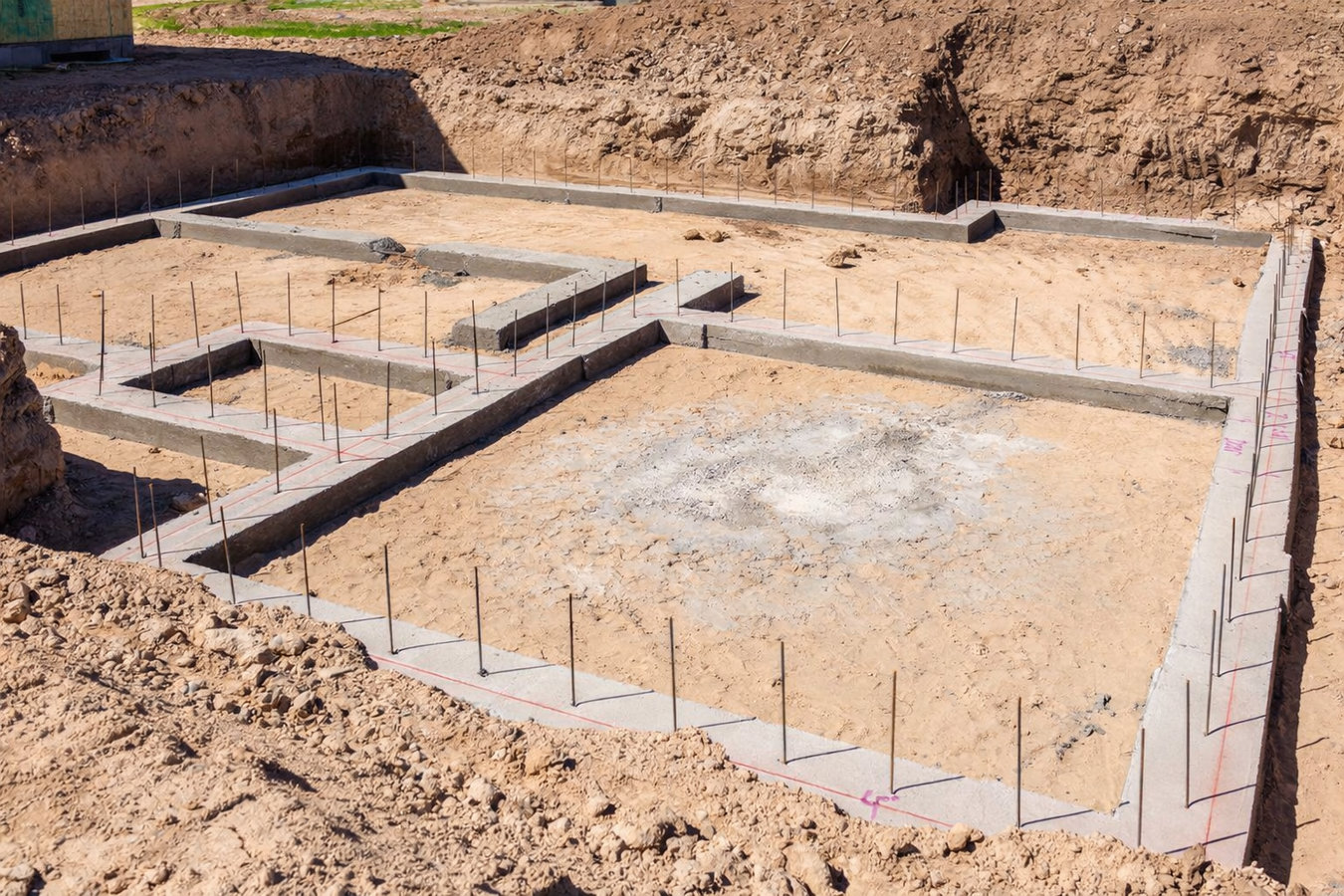
Everything above your foundation depends on the ground below it. We install concrete foundations that handle Queen Creek's expansive soil, meet town permit requirements, and cure properly in the desert heat.
Foundation installation in Queen Creek covers the full process - site grading, soil treatment, steel reinforcement, concrete pour, and curing - from the first permit application to the final town inspection. Most residential foundations take one to two weeks from permit approval to a cured, load-bearing slab, depending on lot conditions and permit timelines.
Your foundation is what every wall, floor, and roof above it depends on. In Queen Creek, where the ground contains expansive clay that swells with monsoon rains and caliche layers that require breaking before the soil can be properly compacted, getting the sub-grade preparation right is the difference between a foundation that holds for decades and one that shows cracks within a few years. The prep work is largely invisible once the concrete is poured - which is why choosing a contractor who does it correctly matters so much.
If you are also concerned about existing movement in your structure, our foundation raising service addresses settled or uneven foundations that need to be lifted and stabilized before new work can proceed.
The most straightforward sign you need foundation installation is that you have a structure to build and nothing under it yet. If you are starting a new home, detached garage, room addition, or accessory dwelling unit in Queen Creek, a properly installed foundation is the first step - and everything else depends on it being done right.
If interior doors that used to swing freely now drag on the floor or refuse to latch, or if window frames look slightly out of square, the structure above the foundation may be shifting. In Queen Creek, this is often tied to soil expanding and contracting with seasonal moisture changes. It does not always signal a catastrophic problem, but it is worth having a professional look at before the movement gets worse.
Hairline cracks in a concrete slab are common and usually harmless. But cracks wider than a quarter-inch, running diagonally from door corners, or with one side visibly higher than the other are signs of uneven foundation movement. Queen Creek's expansive clay soils make this type of cracking more common here than in areas with stable sandy soil.
If standing water collects against your foundation after a summer storm, that moisture is working into the concrete and the soil beneath it. Repeated wetting and drying cycles weaken the slab and accelerate the soil movement that causes cracking. This is a particularly relevant warning in Queen Creek, where storms can dump an inch or more of rain in under an hour.
We handle every stage of foundation installation, starting with a site visit to assess your specific lot - soil type, drainage pattern, and access conditions - before a single permit application is submitted. That assessment shapes the design: footing depth, rebar spacing, gravel sub-base depth, and moisture barrier placement are all determined by what is actually under your property in Queen Creek, not a generic template. We manage the complete permit process through the Town of Queen Creek's Development Services department and schedule every required inspection so nothing falls through the cracks on your project.
For projects that also need structural concrete work above the slab level, our concrete parking lot building service is available for commercial and multi-unit properties that require a foundation and flatwork plan handled by the same crew. Coordinating both with one contractor keeps the sequencing and inspection timeline clean.
New homes, garages, and additions in Queen Creek - the standard foundation type across the East Valley, suited to the dry desert climate and local soil conditions.
Single-pour slabs where the footing and floor are poured together - efficient for smaller structures and lots where soil conditions are stable enough to support this approach.
Properties that need the slab elevated above grade - common on lots with drainage challenges or where the grade has not been fully established before building begins.
Permitted slab pours for room additions or accessory structures that tie into an existing home without compromising the original foundation.
Queen Creek sits on desert soils with two characteristics that make foundation work more demanding than in most of the country: clay-heavy layers that expand and contract with every rain cycle, and caliche - a hard calcium-rich layer that needs to be broken up before the soil can be properly graded and compacted. Both conditions are present across the Queen Creek area, though they vary by neighborhood and lot. A contractor who designs every foundation the same way, regardless of what the soil actually shows, is skipping the step that matters most for long-term performance. The Arizona Geological Survey documents the distribution of expansive soils across Maricopa County - and much of Queen Creek falls within areas where soil assessment before a pour is essential, not optional.
We work regularly across the East Valley, including in Chandler and Gilbert, where similar soil conditions and HOA requirements are standard. Many of Queen Creek's newer planned communities require HOA approval before any ground is broken - a requirement that a contractor unfamiliar with this area might overlook entirely. We ask about your HOA at the first conversation so that approval is in hand before the permit is even submitted.
Call or submit a form and we respond within 1 business day to schedule a free site visit. We assess your lot conditions and ask about HOA requirements before giving you a written quote that breaks out labor, materials, soil prep, and permit fees - no bundled totals that obscure what you are actually paying for.
We submit the building permit application to the Town of Queen Creek's Development Services office. Processing typically takes a few business days to two weeks depending on current department workload. During this time we also arrange a soil evaluation if one has not already been done for your lot.
Once the permit is approved, the crew grades and compacts your lot, removes or treats problem soil layers, and lays the gravel base and moisture barrier. Forms are set, rebar is placed according to the approved plans, and a town inspector visits for the pre-pour inspection before concrete is ordered.
The concrete trucks arrive and the pour is completed in a single session. The slab is then protected and cured - kept moist or covered during the early days to guard against Queen Creek's heat. Once cured sufficiently, the town conducts a final inspection and you receive the passed records to keep with your home files.
We respond within 1 business day - no obligation, no pressure. After you submit, someone from our office will call to schedule a free site visit so we can assess your lot conditions and give you an accurate written price.
(480) 919-2298Our Arizona Registrar of Contractors license covers structural concrete work - the specific classification required for foundation installation in Arizona. You can verify the license status online before signing anything. Hiring unlicensed contractors for foundation work leaves you with no state-level recourse if something goes wrong.
We pull every required Town of Queen Creek permit, attend every scheduled inspection, and deliver the passed inspection records to you when the job is done. That documentation protects your investment - particularly if you ever sell, refinance, or add onto the structure. Unpermitted foundation work is one of the most common deal-killers in Arizona real estate transactions.
We install foundations across 12 cities in the Phoenix metro, and Queen Creek's soil conditions - expansive clay and caliche - are standard conditions we design for on every job. The footing depth and reinforcement decisions we make are based on what your specific lot's ground actually requires, not a one-size approach.
A large share of Queen Creek's neighborhoods require HOA approval before any ground is broken - and a contractor who does not ask about this can get your project stopped before the crew ever arrives. We confirm HOA requirements at the first conversation and build that timeline into the project schedule so it never creates a delay.
Foundation installation is the kind of work where the most important decisions - soil prep, reinforcement, curing - are invisible once the pour is done. The National Association of Home Builders outlines the standards residential contractors are expected to meet on foundation work - a useful benchmark when evaluating any contractor you are considering for a structural project.
Commercial and multi-unit flatwork built on a properly engineered base - often planned alongside foundation work for Queen Creek development projects.
Learn moreLifting and stabilizing settled or uneven foundations before new construction or remodeling work can safely begin on a Queen Creek property.
Learn moreCall now or submit a form - we respond within 1 business day and schedule a free on-site visit. Contractor schedules in Queen Creek fill fast during peak building season, so reaching out early keeps your project timeline intact.